THE MUSICAL BOX
The Continuing Adventures
The Ninth Time (. . . and then there was. . . PHIL, 23 October 2026)
Keswick Theatre, Glenside PA
Set: Eleventh Earl of Mar/One for the Vine/Deep in the Motherlode/Ripples/Wot Gorilla?/The Story of Albert (Behind the Lines/Duke's Travels/Duke's End)/Dance on a Volcano/Entangled/Squonk/Burning Rope/Blood on the Rooftops/Unquiet Slumbers for the Sleepers . . ./. . . In that Quiet Earth/Afterglow/Follow You Follow Me/In the Cage/It's Yourself/Los Endos
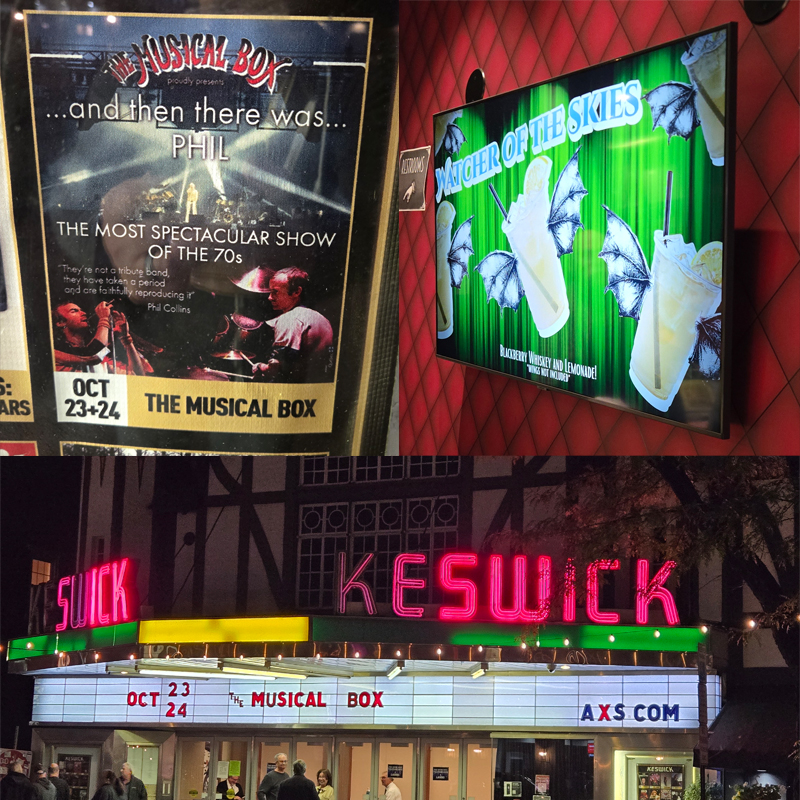
In 2026 I bought my own birthday present: another trip to see The Musical Box, which - as the website pages here confirm - would make my ninth. The most convenient venue and time in my estimation ended up being way over in Pennsylvania, an hour-and-change drive from my New Jersey homestead, and would return me to the Keswick Theatre for the first time since my fourth viewing of the band, all the way back in 2004 (before either of my two children had been born). The driving force for my seeing them again this time was the fact that they were back doing songs from the Phil Collins era of Genesis, something I'd never heard them do before.
Since I now work from home permanently instead of being forced to commute all the way up to Saddle Brook, the drive over to the town of Glenside was much less stressful than it had been twenty-two years previously, and we arrived well before the show time of 8 PM - rare punctuality in our long history of seeing Musical Box shows. We found the town unchanged from my description of 2004 (as I confirmed when I peeked back at my own review). My wife and I had ample time to take in a very greasy meal at a burger place across the street from the Keswick, and even time to amble over to the theatre's connected bar for a cocktail. The bar was offering a drink special called the "Watcher of the Skies," and even though (as the advertisement was quick to clarify) it didn't come with the pair of bat wings pictured flanking the glass, I was still keen to order it. My words to the bartender were met with complete confusion: "What the hell is that?" he asked. After finally realizing that I was loudly repeating the name of their drink special, he mixed me up something which I'm pretty certain in no way matched the description of the drink on the ad. Whatever: it tasted nice, and made for a good story after, indicative of the bemusement most people experience when being told about Genesis tribute bands.
Going to our seats, we found the theatre itself also unchanged in the intervening years, its quaint and barely comfortable chairs as venerable as the old-fashioned interior. The seating in slightly staggered, mostly level rows also does not allow for an unobstructed view of the stage, as both of us were to discover. (Both the wife and I spent a lot of the evening craning our heads around the heads of the people in front of us.) Still, it gives that small-theatre vibe that the original Genesis has claimed to find preferable to giant arenas.
The show began promptly. Previous performances by TMB have been all about authenticity to whatever Genesis tour was being presented. This tour, we were to learn, was a very different animal. The main nod to historical accuracy came in the staging, with a lighting rig cocooning the stage and featuring a roof of revolving "mirrors" faithfully mimicking those used in the And Then There Were Three (AKA "Mirrors") tour. I'd read beforehand that the band (the one I was watching, not the real Genesis) had consulted the original person who designed the Genesis lighting rig to make sure this one was legit. The mirrors themselves were not the usual glass you'd have hanging in your bathroom, but some more flexible material less prone to shattering. Still, they were reflective and offered some cool effects when lights were pointed at them and bounced off in various directions. There were also the obligatory smoke machines, combined with lasers to make some trippy visuals.
The opening number was "Eleventh Earl of Mar," a solid choice that just happened to be the regular opener during Genesis's 1978 world tour. Then "Phil" (AKA Denis Gagné) had his first talk with the audience. In my last review of their 2024 tour for the anniversary of Selling England, I was finally able to give a complete band lineup for TMB, after years of its not being easily accessible online. I'm once again back to having that problem, having been unable to locate a lineup for this current tour. I think that most of the members of the band are the same as they were in 2024, with everyone filling the same roles - except of course Denis, who has transformed from Peter to Phil; and the drummer. More on the drummer later. Denis always worked hard on duplicating the 70s Peter Gabriel mannerisms, movements, and stories. He did that to an extent with his Phil performance. He was wearing the more casual kind of clothing that Phil would have worn during this period, including the trademark wrist sweatbands. Throughout the show he would give the audience thumbs-ups and lean towards them to evoke reactions in a very Phil-like way, and repeated the formulaic "Thank you, thank you very much" to us so often and in such a similar intonation that the people sitting behind us started mimicking him.
As for stories, Denis to a certain extent copied those as well; but his first intro to the crowd showed right away that he wasn't going to be "in character" the whole time, and the band were not going to recreate any specific tour. He greeted us all and told the brief tale of Genesis in 1975, having lost their lead singer and finding a new one at last from among the remaining group members. Then he explained that they would only be playing songs from the range of years on the posters: 1976-1980. I thought perhaps this meant the band would be playing songs that Genesis might have played during the tours in those years, which would open the door to various Gabriel-era classics; but no, as you'll see from perusing the set list, they (mostly) stuck only with Phil-era songs. The brief, I think, was to prove - as Denis suggested a bit during his first intro - that Genesis was still a prog rock power house, even without Peter there to helm them. The songs were likely chosen deliberately to prove this premise, so some of the more pop-type hits ("Misunderstanding," "Turn It on Again," "Your Own Special Way") were avoided in favor of more muscular, instrumental-heavy, multi-section tunes.
As for the song intros, Denis did get around to telling some that were very similar to what Phil would have told. For instance before "Deep in the Motherlode" he talked about the Gold Rush - not the Acapulco Gold Rush, or the Lebanese Gold Rush, but the American one. Before "Ripples" he warned us the song was about the passing of time, old age, and was dedicated to plastic surgeons lying on beaches. Not having consulted any sources about what was actually going to be played, mostly because I wanted to be surprised, I was making note of each song as it came, and based on Denis's familiar stories I was able to write down most of the song titles before the band started playing them. But after "Ripples" came the first really surprising choice in the set list, and the first one without an introduction: "Wot Gorilla?," the goofy little entirely instrumental adventure that ended Side 1 of its album. Not only was it a very odd song to play in terms of popularity and recognizability, it has the distinction of having almost never been played live by Genesis! (According to my site, it was only played on the first night of the WW tour, 1/1/77.)
After that we were back in familiar territory, I thought, because Denis began relating with a fair bit of accuracy the old "Story of Albert." As he talked about the born loser Albert and his difficult love affairs and eventual success with novel and album writing, I confidently wrote down the full chunk of songs that 1980 Genesis played in their "Songs from our album called Duke" medley. As it turned out, though, TMB played a much-abbreviated version of this, omitting "Duchess," "Guide Vocal," and the aforementioned "Turn It on Again." I suppose they wanted to have time to explore other parts of the band's song list from their chosen time range, and as I said before were trying to avoid the less prog-like songs; but this choice again felt unexpected and odd. Why approach "Turn It on Again" so closely ("Duke's End" features a reprise of the song's main theme, pointedly reminding listeners that the tune exists and is in that time period) and then not play it? It was always a great and very rousing live number.
Still, I don't want to be one of those people who's given an amazing show and then complains about all the things that weren't in it. The performance so far had been up to TMB's usual standards of excellence, with all the songs played with great aplomb. "Ripples" in particular used the lasers to great effect, with a double sine wave animation projected onto the non-reflective back of one of the rotating mirrors, to represent the song title. "Tony" made one pretty obvious flub somewhere near the beginning of "Duke's Travels," the complicated notes of one passage going wrong. I saw his mouth curve down and he said something aloud (and probably self-deprecatory) to himself or the band, which was lost in the otherwise glorious noise. While I'm on the subject of Tony, it seemed to me that several times over the course of the night his keyboards used presets that varied from the ones the real Tony would use in the same situation. I don't know if this was a limitation of their equipment, a goof, or just a choice on his part.
After the Duke passage the band took a short break. They came back on with a song I knew they would have to play, and one of the ones I'd most been looking forward to: "Dance on a Volcano." To me this track epitomizes the power and majesty that Genesis managed even after Peter's departure, and is easily one of my favorite songs of theirs. But the performance was a bit of a miss for me. Here's where I have to talk about the drummer. He doesn't appear to be Marc Laflamme anymore, the guy who filled the role of "Phil" during their Peter-era tours. It was a younger man with very long hair (actually all the band sported big shaggy manes, perhaps a nod to the late 70s era they were trying to evoke), and I wondered whether he was going to be playing as "Bill Bruford" or "Chester Thompson," or maybe even the drumming persona of "Phil Collins." In the end I couldn't detect much of the style of any of those drummers in his playing. I don't have a fantastic ear for these things, but Bruford's style is fairly distinctive. As for the rest, I could trust my memory of hearing a million performances of some of these songs to know when expected fills or flourishes were supposed to come in, and very often they did not, or at least not in the way my ear was expecting. I still thought the drumming was great: good and loud and fierce, driving the band along. "Volcano" was the first song where it went wrong for me. During the verses it seemed that somehow Denis and the drummer were off-sync with each other, the rhythm getting muddy and almost lost. It felt as if the band was about to lose the thread entirely.
The end of the song brought another surprise, as the band played the full track, including its concluding "dance" section - something that Genesis, again, hardly ever did live (only during the 76 tour where it debuted). This chunk of the show marked a big Trick of the Tail passage, during which they played nearly the whole first side of the album, in order. After "Volcano" Denis gave the usual intro for "Entangled" (which in fact would usually have been told by Steve), referencing the painting by Kim Poor and Tony's "Maria Callas" style of synthesizer playing. The song sounded fantastic and was enhanced with lasers and smoke. Then it was right into the dark, pounding "Squonk."
Next came a song which, while it was a regular live number for the band in 1978, still came across as an odd choice for me. Given all the amazing prog masterpieces to choose from in the range of 1976-1980, why go with "Burning Rope"? Still, it was another solid performance. And it was followed by a real treat, if one not selected for historical accuracy: the gorgeous Hackett-penned tune "Blood on the Rooftops." Genesis famously never played this song live, ever; but TMB made me wonder, all over again, why (probably because poor Steve got no respect!). The opening guitar passage I've always found amazingly beautiful, and the song that follows is wonderfully atmospheric and quintessentially British. And speaking of songs never played live: right after that the band went right into "'Unquiet Slumbers for the Sleepers . . .,'" the beginning of the larger medley that ended Side 2 of Wind and Wuthering, and another track which Genesis never bothered to perform before an audience. TMB played the whole suite of songs, right into the Genesis live staple "'. . . In that Quiet Earth,'" always a heart-thumping sonic explosion, and the emotional conclusion of "Afterglow." This ended their main set.
When the encores came along, I admit I cheated. Having had no idea before now which songs were coming next, and no interest to know, I happened to catch the glow of the phone screen of a man sitting to my left in the next row up, who had gone ahead and googled the set list and was showing his friend (the guy sitting just next to me) the encores. With it right in front of me, I couldn't resist the temptation and peeked. I found it hard to believe what I saw, since the page listed four songs. I thought maybe it was listing a sampling of the various different encores they had played so far on the tour. But no - they played all four. Technically the last two were sort of one song, since as Denis himself told the audience, it is kind of hard to tell where one ends and the other begins.
The first two songs also broke the rules the band had made for itself up until then, in a couple of ways. "Follow You Follow Me" was by any measure a pop single, often cited by fans and critics alike as the first whiff of commercial rock in Phil's version of the band. TMB, I thought (and it feels a little like sacrilege to even write it), turned in a fairly lackluster performance of the tired old track, almost as if they themselves would rather not be playing it. Having already conceived a lack of confidence in him, I had to wonder whether the drummer was making things worse by not playing the backing rhythm with the free-and-easy swing style it deserved. The next song went too far in the other direction, as Denis was forced to admit that - having promised that all the songs would be from the period of 76-80 - they were about to play one that came a little before that. Having heard it on a million bootlegs, I can get a little tired of "In the Cage;" still, it was almost a necessity with the band and staging they had: the song's "keep on turning" ending was a perfect match for the revolving mirrors and smoky lasers. The original 1978 tour with the mirrors had been the first one to bring back the song since its first round of performances in 1975.
The last number veered again into territory that Genesis had feared to tread. One of the reasons being, as Denis pointed out, that the song was a track that never made it to an album; "It's Yourself" was a B-side from the Trick of the Tail sessions. The cool thing about the song, though, is that it was written to flow seamlessly into the opening section of "Los Endos;" and that is how the band played it. It was very cool to hear this happen live, and "Los Endos" was a fantastic way to close out the night - including that opening section, which after 1976 was omitted from Genesis's live playings of the song. Unfortunately there was another tiny flub near the end of the song, with some technical problem dropping "Steve's" guitar out of the mix during an important bit.
So you'll see that, while I usually worship TMB's skills and powers, and I did enjoy the heck out of most of this show, I came out of it with more mixed feelings than I usually have. I still don't want to be "that guy," but it's hard not to think of the things that could have been in this set. It would have been really cool to hear the entire Story of Albert, for instance, and "Your Own Special Way" is a song that's really grown on me over the years and I think would have been a nice one to hear. Of the 1978 tunes, in particular I missed a common live pairing: "Say It's Alright Joe" and "The Lady Lies." I've long felt the ATTW3 album is one of the band's most uneven efforts, made during a time of transition when they were again attempting to find themselves. But some songs, like the two I mentioned, worked really well live, and in particular I thought the audience participation bit that was put into "The Lady Lies" would have been fun to experience. Their rarer and more interesting choices of songs, while exciting for rarity's sake, put the band somewhat at odds with their usual mission of recreating the true Genesis live experience.
As I've already hinted, I'm not sure the band was quite as note-perfect as I've known them to be in the past. There were a couple of slight hiccups, and there was the drummer, who did a fantastic job but may not have quite mastered all the songs. I should add, while I'm talking about drumming, that Denis took his Phil role serious enough that he would also occasionally run to a spare drum kit and do some banging away. I have no idea how experienced the man is as a drummer, but I would bet he's not as good as the real Phil - ha. His stints at the kit were markedly short and while they did bring some noticeable added power (those double cymbal crashes almost made my teeth rattle), it was usually subtle, and we didn't get any flashy drum duets.
I will never not love this band, however, and their decades-long commitment to my favorite music. I am so glad I got to see this incarnation of them, and I understand the choices they made even if I don't necessarily agree with every one. In retrospect I realize it wouldn't read as well with audiences to accurately reproduce one specific tour from the Phil years, since there were fewer staging and performance quirks after Peter left to single any one out; and the technological innovations that the big-arena Genesis brought to their live act would be impossible to reproduce in TMB's smaller-scale venues. All in all, this was a cool experience. There were plenty of moments where I was sitting there with a big stupid grin on my face, taking in what was happening. It was a very pleasant surprise to get "Blood on the Rooftops," and the many instrumental passages - even "Wot Gorilla" - were impressive in the extreme.
I'll close as I usually do, with the hope I can continue to listen to bands like TMB bring Genesis back to life.